
RM
Rainbow Memory: Continual Learning with a Memory of Diverse Samples
arxiv | CVPR 2021
0.Abstract

- 本文关注的‘blurry’ task boundary 渐变增量任务(任务间共享类别),过去的类增量持续学习方法中(disjoint),不同任务中的类别互不交叉
- 样本的多样性更为重要(diversity of samples)
- 样本分类不确定性
- 数据增强
1.Introduction
Contributions
- a new diversity-aware sampling method for effectively managing the memory with limited capacity by leveraging classification uncertainty——选取多样性的样本放置在 Memory 之中
- augment the samples in the memory to further enhance the diversity of the samples——Data augmentation 来进行多样化
2.Related Work
3.Method
Diversity-Aware Memory Update
most discriminative:near the classification boundary
most representative:close to the center of the distribution
Diversity Enhancement by Augmentation

那么,如何通过预测概率的变化定义不确定性呢?作者进一步计算预测类别的变化来评估不确定性,具体来说,就是评估多次扰动中,最经常类别的命中次数占总实验次数的比例,形式化如下,其中 $c$ 代表类别,$S_c$ 代表第 c 类的被预测为 top1 的次数,$u(x) $ 不确定行性指标。
即样本经过变换之后,比如遮挡、平移、旋转等等,如果在模型中的输出的结果方差越大,样本越难,则说明此样本越 diverse. (这里作者的解释并不清晰,逻辑关系有点模糊,因为模型经过变换之后在网络中的输出结果不确定,并不能说明这个样本就靠近 decision boundary)
假定样本为$x$,经过 perturbed(这里意思是变换和扰动)的样本为$\hat{x}$, 则$\hat{x}$ 模型预测出的不确定性越高,说明这样本越 diverse.(这里借鉴了主动学习的思想,相当于保留难样本)
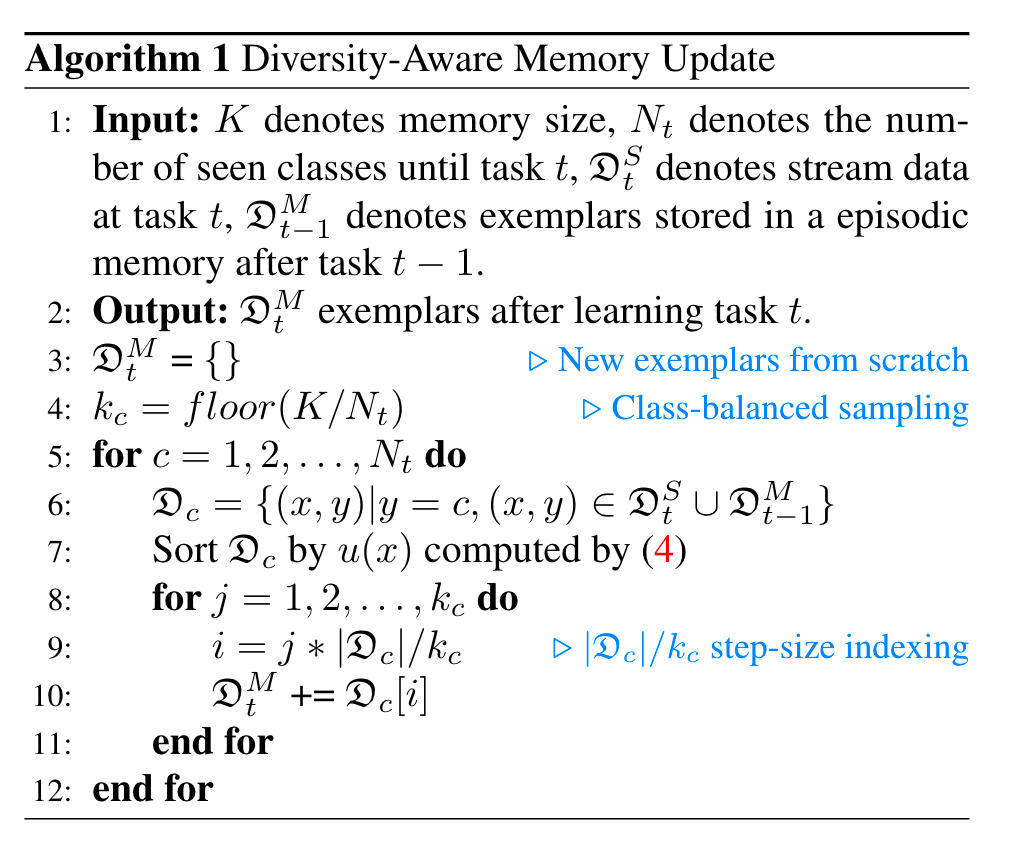
按不确定性指标排序后进行均匀间隔采样
Diversity Enhancement by Augmentation
‘mix’ images in the classes of the new tasks and the exemplars of the old classes in the memory
4.Experiments
5.Conclusion
6.Reference
- 论文分享:Rainbow Memory: Continual Learning with a Memory of Diverse Samples
- CVPR2021 论文详解 Rainbow Memory: Continual Learning with a Memory of Diverse Samples
本博客所有文章除特别声明外,均采用 CC BY-NC-SA 4.0 许可协议。转载请注明来源 Hongwei Zhao's Blog!
相关推荐

2025-11-16
iCaRL
iCaRL: Incremental Classifier and Representation LearningAbstract classifiers data representation Introduction 类增量学习算法应满足: it should be trainable from a stream of data in which examples of different classes occur at different times,(可训练) it should at any time provide a competitive multi-clas...

2025-11-16
RKR
Rectification-Based Knowledge Retention for Task Incremental LearningTPAMI 2024 | 无需重训练即可掌握新技能,深度学习模型实现终身学习革命! 摘要在任务增量学习问题中,深度学习模型在训练新类别/任务时会遭受之前见过的类别/任务的灾难性遗忘。当一些测试类别不属于训练类集时,这个问题变得更加困难,即任务增量广义零样本学习问题。我们提出了一种新的方法来解决非零样本和零样本设置中的任务增量学习问题。我们提出的方法,称为基于校正的知识保留(Rectification-based Knowledg...

2025-11-16
LwF
Learning without ForgettingLwF算法是基于深度学习的增量学习的里程碑之作,在介绍LwF算法之前,我们先了解一些最简单的增量学习方法。 上图展示了一个具有多头网络结构的模型学习新任务的不同策略,其中(a)为已经训练好的基于CNN的原始模型,$\theta_s$ 示不同任务共享的CNN参数,$\theta_o$ 示与原始任务相关的MLP参数【旧任务的分类器】,当加入一个新的分类任务时,我们可以增加一个随机初始化的MLP参数$\theta_n$【新任务分类器】。基于$\theta_s,\theta_o$ 学习$\theta_n$ 方法包括如下几类: 微调(F...
2025-11-16
PILoRA
0. 摘要现有的联邦学习方法在涉及数据隐私和非独立同分布(Non-IID)数据的场景中,已经有效地处理了去中心化学习问题。然而,在实际情况下,每个客户端动态学习新类,要求全局模型能够对所有已见类别进行分类。为了在低通信成本下有效缓解灾难性遗忘和数据异质性问题,我们提出了一种简单而有效的方法,称为 PILoRA。一方面,我们采用原型学习来学习更好的特征表示,并利用原型与类别特征之间的启发式信息设计了一个原型重加权模块,以解决由数据异质性引起的分类器偏差,而无需重新训练分类器。另一方面,我们将增量学习视为学习不同任务向量的过程,并将其编码在不同的 LoRA 参数中。因此,我们提出了增量 Lo...
2025-11-16
类增量学习综述
基于 Class-Incremental Learning: A Survey Data Data Replay Direct Replay Generative Replay Data Regularization 基于回放的增量学习的基本思想就是”温故而知新”,在训练新任务时,一部分具有代表性的旧数据会被保留并用于模型复习曾经学到的旧知识,因此要保留旧任务的哪部分数据,以及如何利用旧数据与新数据一起训练模型,就是这类方法需要考虑的主要问题。 Direct ReplayGenerative ReplayData RegularizationModel Dyna...
2025-11-16
Continual Learning With Knowledge Distillation A Survey
0. 摘要持续学习中的首要挑战是缓解灾难性遗忘,使模型在学习新任务的同时保留对先前任务的知识。知识蒸馏(KD)作为一种正则化方法,因其在学习新任务时通过模仿早期模型的输出来保持模型在先前任务上的性能而受到广泛关注,从而减少遗忘。本文对图像分类领域中采用 KD 的持续学习方法进行了全面调查。我们详细分析了 KD 在持续学习方法中的应用,并将其应用分为三种不同的范式。此外,我们根据所使用的知识源类型对这些方法进行了分类,并从损失函数的角度深入探讨了 KD 如何巩固持续学习中的记忆。我们还通过在 CIFAR-100、TinyImageNet 和 ImageNet-100 数据集上对十种集成 K...
